
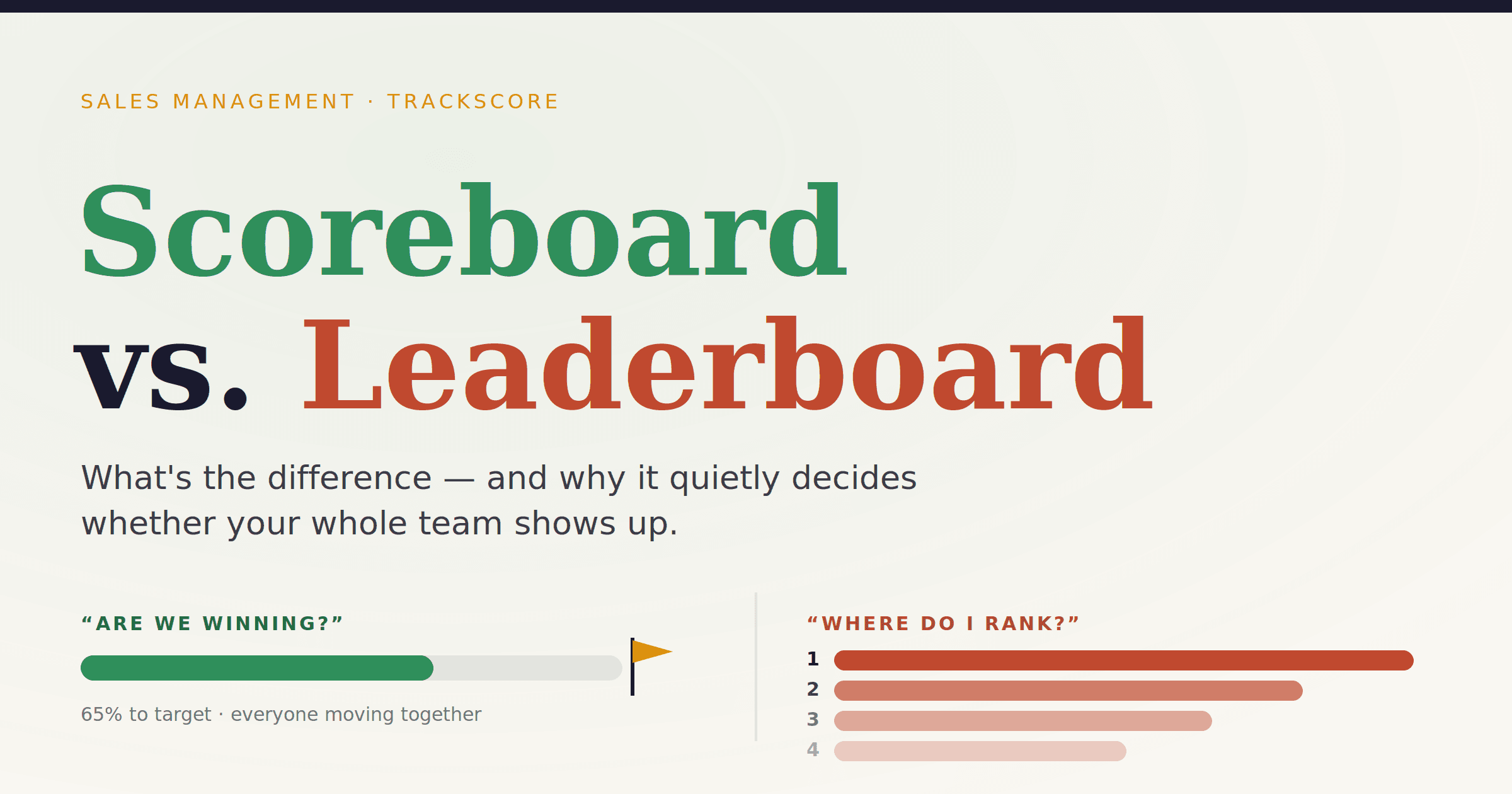
Sales team scoreboard app vs. leaderboard: What's the difference?
The leaderboard had been bolted to the wall for three weeks before I noticed who wasn't looking at it.
The top two reps glanced up constantly—every closed deal was a reason to check whether they'd pulled ahead. The bottom third had stopped looking entirely. Not out of spite. Out of self-preservation. Watching your name sit in last place on a 55-inch screen all day is not a motivation. It's a slow, public erosion. The thing we'd installed to fire up the floor was quietly demoralizing the exact people we most needed to reach.
That experience is what taught me the distinction that almost nobody in sales software bothers to draw: a scoreboard and a leaderboard are not the same tool wearing different names. They answer different questions, they produce different behavior, and confusing them is the most common reason a "sales team scoreboard app" ends up making a team feel worse instead of better.
A leaderboard answers a question your reps never asked
A leaderboard ranks people against each other. Rep A is first, Rep B is second, and the entire emotional content of the display is position relative to peers. It's a ranking instrument, and ranking is inherently zero-sum—for someone to move up, someone moves down.
This taps into something deep and old. Leon Festinger laid out social comparison theory in 1954: people have a drive to evaluate themselves, and in the absence of objective standards, they do it by comparing to others. A leaderboard weaponizes that drive. But Festinger also noted the catch that sales managers learn the hard way—comparison feels good when you're winning it and corrosive when you're not.
Recent work makes the asymmetry concrete. A 2025 study in the Journal of Business Ethics on relative performance disclosure found that pay transparency had heterogeneous effects: it amplified the salary demands of top performers while dampening those of lower-ranked individuals. Visibility doesn't lift everyone. It splits the room. The people at the top get bolder; the people at the bottom get quieter.
Here's the part that contradicts what most vendors will tell you when they sell you a "leaderboard with gamification." A leaderboard is genuinely motivating for roughly the people who don't need much motivating—the front-runners. For everyone else, it's a status report on a contest they're losing. And in a typical sales org, that's most of the team.
| Scoreboard | Leaderboard | |
|---|---|---|
| The question it answers | Are we winning vs. the goal? | Where do I rank vs. peers? |
| Reference point | A target everyone can reach | Other people (zero-sum) |
| Who it energizes | The whole team | Mostly the top ~20% |
| Emotional effect | Shared momentum | Splits the room |
| Best used as | Always-on default display | Short, multi-category contests |
| Main risk | Too complex to read fast | Demotivates the middle & bottom |
A scoreboard answers the question that actually drives behavior
A scoreboard answers a completely different question: are we winning against the goal? Not against each other—against the target. Forty deals needed this quarter, twenty-six in. Eighteen demos booked, target was twenty-five. The reference point isn't a colleague. It's a finish line everyone can theoretically reach.
The clearest articulation of this comes from Chris McChesney, Sean Covey, and Jim Huling in The 4 Disciplines of Execution. They draw a line between two kinds of scoreboards. There's the "coach's scoreboard"—dense, full of every metric, the spreadsheet a manager loves. And there's the "player's scoreboard," and the distinction is the whole game. As they put it, the scoreboard is for the whole team; you need a players' scoreboard with a few simple graphs indicating where you need to be and where you are right now, and in five seconds or less anyone can tell whether they're winning or losing.
Five seconds. That's the test. Not "can a manager extract insight from this," but "can a tired rep walking past the wall at 4pm instantly feel whether the team is ahead or behind."
Their argument for why this matters is almost stupidly simple, and true: people play differently when they're keeping score—if you're not keeping score, you're just practicing. One of the framework's originators, Jim Stuart, put the purpose plainly: the fundamental purpose of a players' scoreboard is to motivate the players to win. Not to rank them. To make them feel the game.
This isn't just consultant theory. FranklinCovey documents Whirlpool using the approach to refocus sales employees on a handful of targetable actions and pulling in an incremental $5.7 million in the first 90 days alone. Marriott built it into how they focus frontline staff on a few critical numbers even through industry chaos. The mechanism in both cases is the same: a visible target, real-time progress, and a clear answer to "are we winning"—not a ranking of who's beating whom.
Why the bottom 70% stops watching
Go back to my wall. The reason the bottom third stopped looking wasn't laziness. It was math.
On a pure revenue leaderboard, there's exactly one winner and a long tail of people who, by design, are visibly not winning. Research in gamified environments has tracked what that does. A 2021 study in JMIR Serious Games found that leaderboards showing overall rankings particularly harm lower performers by accumulating perceptions of repeated failure, while only the mid-to-upper ranked experience a genuine sense of success. A 2022 study in Education and Information Technologies found that in leaderboard-only setups, 31.3% of participants reported negative psychological effects from rank comparisons, and 43.8% engaged in "upward comparisons" to higher-ranked peers that amplified feelings of inadequacy.
Sales practitioners describe the same dynamic in less academic language. One rep, quoted in a piece on Hyperbound's blog, summed up a traditional leaderboard culture brutally: the top five were smug while the bottom five were eventually pushed out the door. Another made the point that comparison-driven competition can flatten a team into copycats: when you're just trying to beat someone else, you start copying what everyone else is doing, which kills your ingenuity.
Notice what's being demotivated here. It's the middle and the bottom—the consistent performers who, in most orgs, are the business. They're the 60–70% who quietly carry the number while the leaderboard celebrates the two people at the top who'd have hit quota with or without a screen on the wall. If your motivation tool only motivates the people who were already motivated, it isn't a motivation tool. It's a trophy case.
The leaderboard isn't dead—it's just narrow
I'm not arguing leaderboards are poison. I'm arguing they're a specialized instrument with a narrow band of safe use, sold as if they were a general-purpose one.
When ranking does work, the conditions are specific. Short, time-boxed contests rather than a permanent fixture. Multiple categories so more than one person can win something—most improved, best conversion rate, most consistent activity—which the team at SPOTIO frames exactly right: a leaderboard demotivates bottom performers when there's only one way to win, and the fix is multiple competitive categories so more reps can earn recognition. Regular resets so the same names don't ossify at the top. And normalization for territory and tenure, so you're not ranking a rep with a Fortune 500 patch against one cold-dialing SMBs.
There's also a finding worth sitting with before you credit any gamification tool with your results. Ryan Buell, Wei Cai, and Tatiana Sandino, in a Harvard Business School working paper revised in 2023, studied a gamified platform rolled out across a professional services firm. The headline number—reported elsewhere as a 35.8% rise in overall sales and a 22.3% boost in client interactions—is real but conditional. Their actual thesis is in the subtitle: The Roles of Office and Leader Engagement. The gains showed up where local leaders engaged with and legitimized the platform through role modeling. The screen didn't do the work. The screen plus a manager who treated it as real did. Hang a leaderboard on the wall and walk away, and you've installed expensive decor.
What this actually means when you're choosing a tool
So you're shopping for a sales team scoreboard app, and every product page promises "leaderboards and gamification" as if those words settle the question. They don't. The question you're really deciding is which one goes on the wall as the default—the thing the team sees all day, every day.
My answer, after watching this play out on real floors, is that the default display should be a scoreboard, and the leaderboard should be a layer you switch on deliberately.
The default should answer "are we winning against the goal." That means a sales team scoreboard app that lets you set an actual target—not just a feed of who closed what—and shows live progress toward it for the team and for each rep against their own number. It should pass the five-second test: someone glances up and instantly knows green or red. It should track a lead measure (calls, demos booked, pipeline created) alongside the lag measure (revenue), because reps can control the lead measures today, and controllability is what turns a passive viewer into a player. A board built only on closed revenue tells your reps how the month already went. A board built on the activity that produces revenue tells them what to do in the next hour.
Then, on top of that, run the leaderboard the way it's meant to be run: as a seasonal contest with multiple winnable categories and a reset date—not a permanent ranking of human worth. This is exactly the layering pattern we built into TrackScore—progress-to-target as the always-on display, with ranking and recognition as something you turn on for a defined sprint and turn off before it curdles. The order matters. Scoreboard as the foundation, leaderboard as the garnish. Reverse it and you get my wall: a tool that energizes two people and teaches everyone else to stop looking.
The deeper point is that the tool is downstream of the question. A leaderboard makes your reps ask am I beating my coworkers, and for most of them the honest answer is no, so they disengage. A scoreboard makes them ask are we winning, and that's a question a whole team can answer yes to, together, on a Tuesday afternoon with eight days left in the quarter.
Walk your floor this week and watch where people's eyes go when they pass the screen. If the top performers look and everyone else looks away, you don't have a motivation problem. You have the wrong question on the wall—and you can change it before the next quarter starts.